NASA's 'Lunar Gateway': Building World's First Space Traffic Control System for Moon Orbit
In a historic move, NASA is constructing the Gateway space station, a lunar orbit transportation hub, as part of its Artemis program.
By News Rush Point Desk
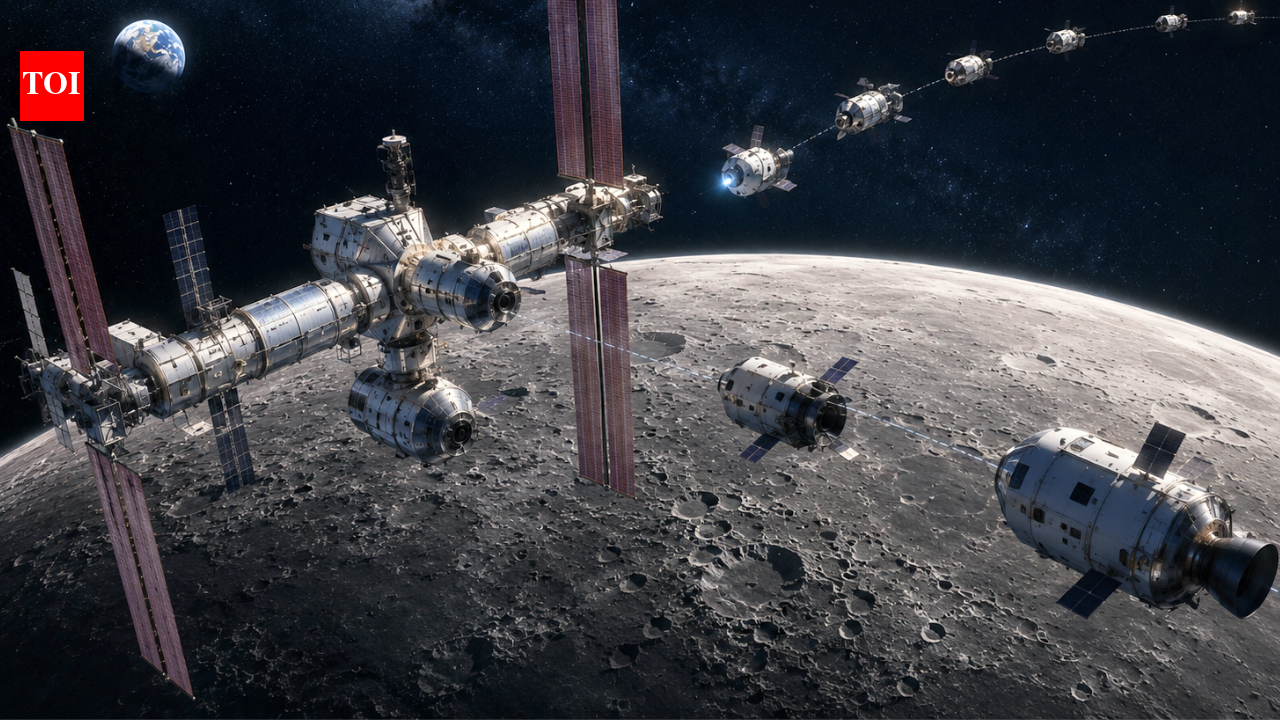
In a historic move, NASA is constructing the Gateway space station, a lunar orbit transportation hub, as part of its Artemis program. Located 240,000 miles from Earth, this space station will serve as a staging point for astronauts, hosting Orion crew capsules, lunar landers, and cargo spacecraft. However, managing traffic in the complex gravitational environment is proving challenging. Researchers from Texas A&M University, NASA's Johnson Space Center, and Purdue University are developing mathematical 'rules of the road' to ensure safe waiting and predictable positions for spacecraft. These rules will be crucial for avoiding collisions around Gateway. Scheduled to launch no earlier than 2027, the station will operate autonomously between crewed missions and accommodate up to four astronauts at a time for approximately 30-90 days. The Gateway's unique near-rectilinear halo orbit, which takes it as close as 1,000 miles from the lunar surface before carrying it tens of thousands of miles away, poses additional navigation and traffic management challenges. To address these issues, researchers are exploring 'loitering' techniques, where spacecraft maintain controlled positions relative to specific orbits while waiting for their next operation, creating a 'string of pearls' along the orbital path.
Filed underWorld
More stories
World
Bangladesh: Over 2,000 Higher Education Professionals Face Political Persecution, Report Finds
World
Collapse at Pakistan's Tarbela Dam Project Halts Construction, Investigation Reveals Design Flaws and Contractual Breaches
World
French Officials Accuse Iran's IRGC of Cyberattacks on Refrigeration Sites Across France
World
White House Briefly Locked Down Due to Car Crash and Barricade Jumping Nearby
World
Trilateral Peace Talks in Abu Dhabi: Ukraine, Russia, and US Discuss Security Guarantees and Territorial Disputes
World